Showing posts with label #author. Show all posts

Saturday, March 8, 2025

My Friend, Luanna Rugh


I first met Luanna when she and her family started attending our church in the early ‘80s. She was very shy, and I didn’t get to know her very well at first.

Her husband, Len, was outgoing and friendly, and so was her daughter, Sandra. Lu’s parents also attended the church, and I got to know them, too. Her dad was sweet and quiet—a real gentleman. And her mom was creative. She made beautiful decorations from shells. I have a magnet on my refrigerator she made as well as an ornament on my Christmas tree.

Len was severely wounded in Vietnam, but I learned quickly enough not to call him “handicapped”! Even though he was missing a large part of his brain and was completely paralyzed on his left side, he believed he could do anything. And the longer I was around him, the more I believed it, too.

After a while, we got to know both of them better. I discovered that Lu had a wicked sense of humor. She might have been shy, but when she opened up, her true personality came forth—sometimes with a vengeance. It took several years, however, before she became comfortable enough around me to let it show. I discovered we both loved irreverence, and she always made me laugh.

From the time Len was wounded in 1969, her goal in life became to encourage him to be everything he could be. He was labeled “unretrainable.” She talked him into attending Saddleback College. He eventually graduated from Cal State Fullerton with a degree in Political Science, even though everyone said it was impossible.


Lu and Len loved to travel. After Sandra left home, they bought a 5th wheel and drove all over the US—including Alaska. Lu did all the driving. They spent time in Hawaii, too, which they both loved. They often stayed in the military hotel in Honolulu and bought timeshares on Maui, which they shared with Sandra and her husband, Steve.

While attending Saddleback, Len began to write a book about his experience in Vietnam. He worked on it for twenty years before he felt it was completed. By this time, Larry and I had joined the same critique group he belonged to (Lagunita Writers). One of our members told Len the book wasn’t finished yet. He’d written all about his experiences in Vietnam, but he hadn’t explained how he had been able to learn to walk and talk and do all the amazing things he’d accomplished. So, after twenty years of working by himself, he invited Lu to help him tell the second part of his story.

When they finally finished, the book was over 1300 pages! His good friend, Larry, told him, “Len, you’ve written the complete book for your family, but now you have to cut it down enough so it will sell.”

Len understood. So, for the next two years, we met with them every Wednesday night, usually at our house. One of us took care of dinner, and then we spent a couple of hours working at the computer cutting the size of the book. We went through it three times, line-by-line, word-by-word, until it was at its final length of 440 pages.

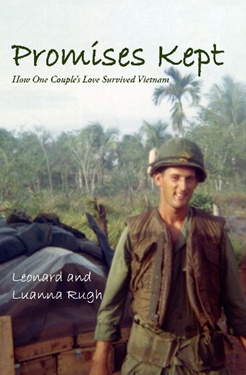
It was published in 2009 as Promises Kept; How One Couple’s Love Survived Vietnam.

Although Lu had written half of the second part of the book, she still told everyone, “I was a biology major. I’m not a writer.” Promises Kept won the 2010 EPIC Award for Nonfiction. It has become hugely popular with veterans’ groups.

While they were working on their book, I started a project with three other friends. It was an anthology about four sisters with a common through-story. However, one of the participants had to drop out because of health issues. We could have made it about three sisters, but the overall outline was for four.

I mentioned it at one of our weekly meetings. The following week, we went down to see Lu and Len at Camp Pendleton where they were spending a week camping. She asked me about the project, and I explained it to her. She asked if she could take part. By the time we left that day, she had outlined her character and the story she wanted to tell.

She was the first one finished with her novella! And hers became my favorite story in the book. Snowflake Secrets was published in 2008, before Len & Lu’s book. From then on, I told her she could no longer say she wasn’t a writer!



This was the first of six anthologies, all set in our fictional town of Aspen Grove Colorado, and Luanna was part of all of them. Seasons of Love came next, followed by Directions of Love, An Aspen Grove Christmas, The Art of Love and …And a Silver Sixpence in Her Shoe. Snowflake Secrets was a 2009 finalist for the Edward Hoffer Award, finalist for the 2008 Dream Realm Award, and a 2009 EPPIE award. Directions of Love won the 2011 EPIC ebook Award for best anthology.



I must have finally convinced her that she WAS a writer because she eventually published two more stand-alone novels: Love From the Sea was published in 2016, and Up in Flames published in 2020.


One thing we shared  in common was a love for everything Disney. We had annual passes, and they got military passes each year. We went with them often. Each time we passed the wheelchair rental, we’d suggest Len rent one.  “Heck no. Those are for people who need them.” Despite his total paralysis, he had learned to walk with a full leg brace (hip to ankle) on his left leg. His left hand was in a sling. He balanced by carrying a cane in his right hand. He’d learned to swing the brace while balancing on his good leg. He couldn’t drive, but he took the bus everywhere. Most of the drivers in Orange County knew him. When we were eating with them in a restaurant, someone would approach and greet him—often a bus driver.

He took part in classes to train physical therapists on how to work with people with his level of paralysis. He called them his “physical torture” classes. But he was proud to have been able to help train others to help people like himself.

He also took part in The Vietnam Head Injury Study. Every few years, he flew back to Washington D.C. for a week of tests and interviews. In later years, Lu went with him. They never could explain how he was able to accomplish so much with as severe an injury as he had sustained. Of course, the real secret was Lu. She knew when to push and when to step back. He never wanted sympathy or help when he didn’t need it, and those of us who spent time with him learned this quickly.

For years, the four of us ate brunch together after church on Sundays. During his last couple of years, Len was in and out of the hospital and rehab. Covid made everything much worse as he was often in quarantine. Lu was at loose ends without him to care for.

He was moved to a nursing home at some distance from their home, and she drove to see him several times a week. After Len died in 2022, Luanna lost much of her interest in life, and we saw her fading. Her memory began to fail, and her zest for life ebbed.

Finally, Sandra moved her into a lovely assisted living facility. She did better there, but she eventually started falling and forgot to take her medications. After yet another stay in the hospital, she was in terrible shape. Once again, Covid quarantines kept us from visiting. When we finally saw her, I was shocked. She could barely communicate, and she looked terrible. I called Sandra about our concerns. She said she couldn’t get any information from the facility and was very frustrated since she lived in Minnesota and Lu was in California.

Shortly thereafter, she moved Lu back to a facility a few minutes from her home. I couldn’t believe the change the next time I spoke with Lu. She was back to her old self! The caregivers at her new place monitored her medications and kept a close eye on her. And she flourished.

She made friends, played Bingo, watched movies, and cheered for the Vikings.

She was terrific for nearly a year. But then, she developed a UTI and was hospitalized. When she finally was well enough to return to her facility, her mental state had reverted to where it was when she left California. And she refused to eat. Being a type-2 diabetic, this contributed greatly to her downhill slide. She was put on hospice for a few days and just seemed to fade away.

I am convinced she is now with her beloved Len, where she has longed to be ever since he died. And I’m sure she is making jokes and laughing. At least, that is how I will remember her.


Friday, September 30, 2022

My Grandparents’ House

My grandparents, David and Mary Ann "Minnie" Methven, purchased the house at 423 Westbourne Dr. in West Hollywood, California in 1929. They moved from the house at 4125 Hammell St. in East Los Angeles, California.

My grandfather built the first house by himself when the family moved to California in 1919. He did everything except the plumbing because his brother-in-law was a plumber. The house is still standing all these years later, although it has been remodeled to such an extent that the original house is no longer recognizable. (I could not find a good photo of it.) Mother and I used to drive by it once in a while just to see if it still existed.

The new house in West Hollywood was much larger than the old house. The family now had three daughters and needed more space.


The story I was told was that the builder had intended to live there himself, but he had to move to another state. Grandpa heard about it from a friend and purchased it.

I have this small painting of the house. Grandma told me that during the Great Depression, itinerant artists went from house-to-house volunteering to paint them for a very small amount of money. The actual painting is about the size of a postcard. It is done on a thin piece of wood and is signed “O.J. Russert” and dated ’33.

Until her death, Grandma hung it next to the front door.

At the time I was born in 1946, my parents lived in the “little house,” an ADU behind the “big house.” My grandfather built the “little house” originally when his father came to live with them. Great-grandpa later moved to the third bedroom in the main house, and my older aunt and uncle, Gordon and Muriel Collin, moved into the “little house.”

It was originally just one room with a Murphy bed with a half bath (toilet and sink) attached. It never had a shower or tub.

When my aunt and uncle moved out, my mother moved in. She lived there when my dad was in the military in WWII. They were married on October 27, 1942 at the Wee Kirk o' the Heather at Forest Lawn Memorial Park when Dad was home on leave, and their reception was held at the house.


Dad and Grandpa added a lovely, large, sunny kitchen and breakfast nook on to the “little house.” My parents still had to go to the “big house” for showers and baths, but it was a cozy place to live.

After over four years in the US Army, Dad was discharged. He first reported on April 21, 1941 and served through November 24, 1945. Since Dad passed away at thirty-seven years of age, the loss of these four-and-a-half years was significant.

My earliest memories are as a baby waking up in my crib, which was shoved against one wall of the living room/bedroom. Mom and Dad were in the kitchen with the lights on entertaining friends. Smoke arose around them (Dad smoked) as they talked. I knew I was supposed to be asleep, and I tried to be as still as possible.

I remember the yellow kitchen with its sheer curtains. These are happy memories of a time when I was safe and cared for.

Every day, when Grandpa came home from work, he walked by the “big house” and tapped on the kitchen window so Grandma would know he had arrived. However, his first stop was the “little house” to see me. He carried me around and talked to me. Sometimes, he took me to the “big house” and pointed out objects: door, table, picture, window, etc. Because of this, I had a 52-word vocabulary at one year old. (Mom wrote all of them in my baby book because she was sure no one would believe her.)

When I was a bit older, Grandpa read to me. Although space was at a premium, the bottom drawer of the dresser was filled with books. Grandma and Grandpa and my parents bought me lots of Little Golden Books. Some of my favorites are still published. I wore out quite a few. It was through Grandpa that I learned to love reading.

Dad and Grandpa loved working together on “projects.” Grandpa adored Christmas. He and Dad built lots of decorations from wood and many “found” items.

They built a whole village of “tiny houses,” most of which were based on real structures. They created a village on the front lawn, surrounded by a miniature picket fence, and covered in Ivory Snow (washing machine soap flakes). They formed street lights from tin cans and wired them to illuminate the “village.”

Later on, they added a Santa on the roof, two large reindeers, and a sleigh full of presents. In this photo, a few of the “tiny houses” are along the wall.


Dad and Grandpa both worked at the Broadway Department Store in downtown L.A. They obtained the reindeer—previously used in a window display—when the store discarded them. After my family moved to Alhambra in 1948, the deer came with us.

Grandpa died of a heart attack at the Broadway at closing time on October 27, 1948. He was just fifty-five years old. I was twenty-six months old, but I still remember him. And I remember the night he died.

I have a memory of standing at the screen door of the “little house” waiting for of his footfalls on the driveway and the sound of his voice. They never came.

Unfortunately, most of the “tiny houses” were lost in a fire in Grandma’s garage a couple of years after Grandpa died.

Ironically, my father also died of a heart attack in the Broadway on February 16, 1954 at opening time. He was only thirty-seven years old.

My grandmother passed away on the 26th of March in 1969, while we were on the road driving to Illinois, where Larry had a job. When we called to let our parents know we had arrived, we learned that they had just attended her funeral. The house was sold a year later, before we returned to California.

I am grateful to have these photos of my grandparents’ home since it was the site of many lovely memories.


Friday, May 27, 2022

IT’S HARD TO SAY GOODBYE

Today, my dear friend, Marilyn Meredith (F.M. Meredith), writes about ending her long-running Rocky Bluff P.D. mystery series. I have been privileged to edit not only this great series but also her other books. She is a wonderful mystery writer.

If you haven’t yet discovered her books, pick one up. (All books in this series as well as her Deputy Tempe Crabtree series can be read out-of-sequence.)

It's hard to say goodbye.

In this case, it’s saying goodbye to all the folks in Rocky Bluff. Reversal of Fortune, number 17, is the last in this mystery series.

Believe me, it was a hard decision to make, but I had multiple reasons. The first one being police procedure has grown far beyond what I’m capable of writing. Yes, Rocky Bluff is a small town, and the police department is woefully understaffed and underpaid. This has been a good excuse to have a lot of work done in a bigger city. In my mind, I see changes coming in the form of higher salaries and more man (and woman) power.

Another reason is I’m moving along in years and have slowed down quite a bit. Though my characters haven’t aged as fast as I have, I felt it was time to wrap up some of the plot threads which have gone on for a while.

And lastly, it’s become harder and harder to come up with new crimes and plausible murder victims and motives.

It will definitely be hard to say goodbye to the characters I’ve created and grown fond of, including my two detectives: Doug Milligan and Felix Zachary and their families. And of course, there is Officer Gordon Butler, a reader favorite. He’s probably the character who has changed the most over the years, going from a by-the-book cop, who nevertheless, stumbled along in so many areas. His love life was always troubled, too, until he met the woman who becomes his wife.

There are also many folks who have appeared from time to time over the years, sometimes playing bigger roles in what goes on in Rocky Bluff in some books than others. In my mind, each and every one is as real to me as the people I’ve been friends with in my ordinary life.

I’m going to miss the folks who live in Rocky Bluff, the good ones and the ones who aren’t so good.

F.M. Meredith will now go back to being Marilyn Meredith.

To see what happens in the final Rocky Bluff mystery check out Reversal of Fortune.


A fortune teller is murdered in the small beach town of Rocky Bluff, California. The RBPD’s investigation uncovers several suspects—all with motives and opportunity. But which one killed her?

The body of a suspect is discovered on the fortune teller’s property. Clearly, the two killings are related, but how? And who killed them?

Meanwhile, the mayor’s daughter, Kayla, whose best friend is Detective Doug Milligan’s daughter, is upset because her mother’s sister wants her to leave Rocky Bluff to live with her in Los Angeles. Can her friends convince Kayla’s aunt to leave her there with her father?


F.M. Meredith, more commonly known as Marilyn, is the author of over 40 books, mostly mysteries including the popular Tempe Crabtree series. She is a member of two chapters of Sisters in Crime and Public Safety Writers Association. She lives with her husband in the foothills of the Southern Sierra.

Check out her F.M. Meredith page on Amazon as well as her Marilyn Meredith page. And find her book page on Facebook.


Friday, May 13, 2022

Sexual Harassment in Novels

Today, fellow author and friend, Janet Greger (J.L. Greger), talks about writing sexual harassment in novels.


Sexual harassment is common in the workplace. #MeToo moments are a way to build empathy in readers for characters and to show, not tell, about what motivates these characters.

The following is an excerpt from the mystery Games for Couples. It’s closely based on a real incident. The character is describing “her longest moment” more than twenty years later to her current partner:


“I seldom speak of it. I was an assistant professor at Michigan State and up for tenure. My department head called me at five and ordered me to come to his office at five-thirty. When I arrived, the main office was empty and dark. There was only a desk light on in his attached office.”


I closed my eyes and remembered. “My department head was standing in front of the big arched window in his office watering his fig tree, which was at least five feet tall. He turned to me and said, ‘The campus tenure committee doesn’t think you are ready for tenure unless I provide more details. I don’t want to bow to their whims.’”


Sanders (the character’s partner) was silent but he put his hand on my shoulder.


“I remember I was angry. I blurted out, ‘I have twenty publications in scientific journals—more than enough to win tenure.’ My department head said, ‘They agreed but doubted your teaching credentials.’ I was even angrier as I pointed out that I’d received a small teaching award and had favorable reviews from my classes. He said, ‘Yes, but I didn’t include that info in your file because I didn’t think those details were necessary. Now I’m too busy to bother.’”


Sanders grip tightened on my shoulder.


“My department head stepped toward me and said, ‘There’s an easy way... to gain my cooperation.’ His brown eyes stared expectantly at me as his right hand reached toward me. The next minute was my longest one. Each second felt like an hour.”


You’ll have to read the novel to learn the character’s response, but her comment below gives insight into the long-term effect of the incident.


“I forgave that department head years ago. What I couldn’t forget was what I learned about myself… That minute changed me.”


Advice for writers: Dramatic moments, like the above #MeToo moment, should not be overly long or overpower the pIot. They are simply tools for developing multi-dimensional characters. As an author you want to build empathy, not sympathy, for the character.


Games for Couples has interesting characters and a strong plot. Here’s a thumbnail sketch:


A biotechnology company is desperately racing to develop cultured meat products—meat made from cells in a test tube—-before their competitors. Disaster strikes. A subject in a clinical trial testing one of their new cultured meat product dies. Was his death caused by sloppy mistakes made by the biotechnology company, sabotage by a competitor, or hidden past incidents?


In this mystery, four women react differently to sexual harassment but all are changed by their #MeToo moments. The book is available on www.Amazon.com.


J. L. Greger writes is a biologist from the University of Wisconsin-Madison who consulted internationally. The pet therapy dog Bug (shown in the picture) in her novels is exactly like her own stoical Japanese Chin. https://www.jlgreger.com

Friday, May 6, 2022

LOSING ONE’S PUBLISHER


Today, fellow writer, John Lindermuth, writes about what happens when an author loses a publisher. We were both published by the same independent publisher who died. It was a challenge for all of us.


What's a writer to do when they lose a publisher?

It's a dilemma many of us have faced. It was the situation confronting me with the death of Billie Johnson, publisher of Oak Tree Press. Regaining the rights to Fallen From Grace and Sooner Than Gold, the first two books in my Sheriff Tilghman mystery series published by Oak Tree, was not a problem.

What to do with the books did pose a problem, though.

The two obvious choices were to find another publisher or self-publish. I've always preferred to work with publishers and didn't feel confident in having the technological skills needed to do a good job of self-publishing.

Fortunately, Lawrence Knorr, my publisher at Sunbury Press, had published The Bartered Bride, third book in the series, and he agreed to reissue the first two books under Sunbury's Milford House imprint.

Dilemma solved.

We'd hoped the books would have been out sooner, but the pandemic and other issues slowed the process. Fallen From Grace and Sooner Than Gold were released on January 31 of this year and are now available from the publisher, on Amazon, and from other popular outlets in both print and Kindle formats.

 Sheriff Sylvester Tilghman is the third of his family to serve as sheriff of the small Pennsylvania town of Arahpot in the waning days of the 19th century.

As Fallen From Grace opens, Syl is a man focused on two problems: finding a new deputy and convincing Lydia Longlow, his true love, to accept his latest marriage proposal. The murder of a stranger in town suddenly makes his life more complicated.

In Sooner Than Gold, he confronts a murder victim with too many enemies, a band of gypsies hunting a man who stole one of their young women, a female horse thief, and other problems while still trying to convince Lydia to marry him.

The books were popular with readers in their first inception, and I believe, for those who haven't read them, lovers of cozy and historical mysteries will enjoy them. Oh, and I might mention, By Strangers Mourn'd, a fourth book in the series will be coming next.


Here's a short blurb for Fallen From Grace:

The 19th century is coming to a close, and Sheriff Tilghman is focused on his two biggest problems: Finding a new deputy and convincing his true love, Lydia, to marry him.

But his problems are about to get more complicated.

The town’s usual tranquility is shaken to the core.

A stranger has been killed.


And one for Sooner Than Gold:

It’s the summer of 1898. The nation, just coming out of an economic slump, has been at war with Spain since April. And Sylvester Tilghman, sheriff of Arahpot, Jordan County, Pennsylvania, has a murder victim with too many enemies. There’s Claude, who is found standing with a knife in his hand over the body. There’s Rachel, a surly teen who admits she intended to cause harm. Then there’s the band of gypsies who claim the victim is the goryo who stole one of their young women. If this isn’t enough to complicate Tilghman’s life, add in threats to his job, a run-in with a female horse thief; scary predictions by a gypsy fortuneteller, and the theft of Doc Mariner’s new motorcar, plus, plenty of good eating, church-going and socializing. And, before all is over, Sylvester solves the crime and even comes a little closer to his goal of finally marrying longtime girlfriend Lydia Longlow.


J. R. Lindermuth is the author of 19 novels, including eight in the Sticks Hetrick mystery series set in a fictional rural community near Harrisburg, PA. A retired newspaper editor/writer, he is now librarian of his county's historical society where he assists patrons with research and genealogy. He has published stories and articles in a variety of magazines, both print and on line. He is a member of International Thriller Writers and is a past vice president of the Short Mystery Fiction Society.

Additional information on his books and writing is available at www.jrlindermuth.net

Friday, April 1, 2022

Left Coast Crime

 Are you going to Left Coast Crime in Albuquerque on April 7-10, 2022?

It’s a conference for mystery writers and readers.

You can help support Great Little Libraries in New Mexico.


Background on Great Little Libraries Program. In 2019, the State of New Mexico identified its fifty smallest public libraries in rural areas. These libraries are on pueblos, in unincorporated towns, or in towns with small commercial sectors. Thus, municipal tax support is usually non-existent, and the New Mexico Rural Library Endowment Fund provides a maximum of $2,500 a year to individual libraries. Most of these libraries were created by grass-root efforts of citizens in the community and function with no paid employees.

Community public libraries are a valuable resource in any state. However, they are particularly important in New Mexico because the state ranked 50th in K-12 education programs in 2018.

Croak and Dagger, the New Mexico chapter of Sisters in Crime, created the Great Little Libraries Adventure to help these fifty smallest public libraries several years ago. We try to supply these libraries with books by our authors and offer to do programs and displays for them to encourage reading and writing. The board for Left Coast Crime agreed to adopt our Croak and Dagger Program in 2021. Thus, all funds raised at the charity auction and all books left over from the Left Coast Crime conference in Albuquerque on April 7-10 will be distributed to New Mexico’s fifty smallest libraries. So, be sure to donate books and bid on items if you attend the conference. For more details on Left Coast Crime see: https://www.leftcoastcrime.org/2022.

Libraries may use the funds for materials, services to support community literacy, or infrastructure challenges that inhibit the library’s literacy mission. Croak & Dagger will request a brief report from each library about how the donation has addressed literacy initiatives in that community.

Learn more about rural towns and pueblos in New Mexico. Although many of the pueblos of New Mexico are famous for their pottery and casinos, agriculture is still a major source of income on the pueblos. If you want to get in the mood for your visit to Left Coast Crime or just want to learn a little about rural life in New Mexico, read a book about the problems in New Mexico agriculture today.

Life is tough on the pueblos of the Southwest. Opportunities and water are always limited. In the thriller, A POUND OF FLESH, SORTA, life gets a lot tougher on the Acoma pueblo when the plague hits the livestock and one man is killed in mysterious accident in a nearby meat packing plant while another disappears. Scientist Sara Almquist thinks she has clues to solve the mysteries if she's not killed first.


Book at: https://www.amazon.com/dp/0960028560


J. L. Greger
was a faculty member in the College of Agriculture and Life Science at the University of Wisconsin-Madison for many years and was involved in a number of outreach program in rural areas. She is now an active member of Croak and Dagger, the New Mexico chapter of Sisters in Crime. https://www.jlgreger.com

Monday, May 24, 2021

ABOUT A BIRD

Luanna Rugh is a close friend. I have edited several of her books. In addition, she participated in all six of the Aspen Grove Romance Anthologies.

Luanna’s stories nearly always include animals—usually dogs. Quite a while ago, she began a story with a scarlet macaw as a principal character. Other projects prevented her from finishing it, but I always loved it—especially the opening.

Up in Flames is a romance with lots of complications.

“Nine—one—one. What is the nature of your emergency?” “Our bird’s stuck in a tall tree.” “Young man, this number is for human emergencies only.” “It is. Honest, lady. My mom was trying to get our macaw down. Now her foot is caught and she’s stuck in the tree, too. I didn’t know what else to do.”

A young widow with a son in a new town, a bird stuck in a tree, an unsympathetic fire captain—how can this lead to romance? Lyanna Thomas and her son, Davey, have moved to Aspen Grove Colorado following her husband’s death. When their macaw, Scarlet, decides to go adventuring, a whole new world opens up for the family.

When our writing group had to stop meeting due to the pandemic, I encouraged Luanna to finish the book, and I did the final edit and formatting.

Larry designed the cover. 


Luanna knows all about macaws and parrots because she has one herself. She totally conveys their behavior. Scarlet is definitely a pivotal character in the book.

If you enjoy romance with a sense of humor, you will love this book.


LUANNA RUGH was born and raised on a dairy in Central California. She always loved animals, cats and dogs, cows and horses, not to mention the many wild animals living in the area. At ten, she decided she wanted to become a high school biology teacher.

Her family moved to Southern California the year she entered high school. Luanna followed her path in college until the summer of 1966. She worked at a local restaurant where she met the love of her life, Len Rugh. They were married in February of 1967. A year and a half later, Len was drafted and sent to Vietnam where he was critically wounded, but that’s another story.

When Len returned to California, she finished school and earned two teaching credentials in 1984.

At age fifty-seven, she discovered she could write when she co-authored the first of the six books in the Aspen Grove Romance Anthologies. She contributed to all six of them.

After she and Len published their award-winning memoir, Promises Kept: How One Couple’s Love Survived Vietnam, she decided to stretch her wings, and write on her own. She loves writing animals as supporting characters. In Love From the Sea, a dog plays a major role. In Up in Flames, another dog and a scarlet macaw are lead characters.

Her books are available in paperback and Kindle editions. Most are also available as audiobooks.

She hopes you enjoy reading them as much as she loved writing them.


Monday, May 17, 2021

A TALE OF TWO CULTURES

I met Carol Van Kirk at church. When she discovered we were authors, she said she had been working on a book for years. I invited her to join Lagunita Writers, our critique group.

She brought chapters of her book, and everyone looked forward to learning more of her story each week. Her writing was outstanding, and she had a compelling story to tell.

Then came the pandemic…

The group stopped meeting, and the majority did not want to continue via Zoom.

I knew Carol was anxious to get her book finished and published. I called her, and we worked on the edit together. When it was ready, she published it.

Her husband, Nick, a graphic artist, produced an amazing cover.


The Yellow Lizard: A Tale of Two Cultures is Carol’s memoir. Written with contributions from her daughter, Allison Langbridge, Carol tells the bittersweet, and often funny, story of sharing the raising of her children between Southern California and Tahiti.

As a recently divorced mom of two teenagers, Carol agreed to paternal visitation rights of every other weekend and a month in the summer for her children. Soon after the marital dust settled, however, Dad moved to the remote island of Moorea in French Polynesia, aka Tahiti.

Thus began summers in Tahiti for these two over-indulged kids. Eventually, Allison graduated from school and settled into a conventional job and lifestyle in California. Her brother Alec, however, fell in love with and married a local vahine, Anne. This bicultural couple launched a vagabond lifestyle between an Island Paradise in the South Pacific and staid Orange County, California, filled with adventures, mostly comical and implausible. When two children arrived, however, they settled into a house in Opunohu Bay on Moorea. Subsequently, Grandma Carol became a regular visitor on this island that many people, including James Michener, have referred to as the most beautiful island in the South Pacific. Over the years, she became familiar with the Tahitian traditions and superstitions, some she embraced, others she found amusing, absurd, and sometimes downright scary.

But when tragedy struck, it was the Tahitians, not her American friends, who brought peace and comfort with their close spiritual connections to nature. Who then, she wonders, are the unsophisticated primitives?

The book includes many photos. I created a video trailer for it (something I rarely do for books I edit).

The book is available on Amazon in print and Kindle versions. I’m sure you will enjoy reading about her adventures in Paradise.

CAROL VAN KIRK is a technical writer and editor, who has written for various publications including alternative healthcare periodicals, trade journals and technical manuals, training manuals and online computer Help systems. She was copy editor three years for the magazine Yerevan, which was circulated internationally.

The Yellow Lizard was written as a project to share her family’s unusual background and history with the younger generation, but it soon grew into a full-fledged memoir. She is currently at work on a book of myths and legends of the Maohi Tahitians. Carol currently lives in southern California with her daughter and great-grandson.