Showing posts with label #Lorna Collins. Show all posts

Saturday, March 8, 2025

My Friend, Luanna Rugh


I first met Luanna when she and her family started attending our church in the early ‘80s. She was very shy, and I didn’t get to know her very well at first.

Her husband, Len, was outgoing and friendly, and so was her daughter, Sandra. Lu’s parents also attended the church, and I got to know them, too. Her dad was sweet and quiet—a real gentleman. And her mom was creative. She made beautiful decorations from shells. I have a magnet on my refrigerator she made as well as an ornament on my Christmas tree.

Len was severely wounded in Vietnam, but I learned quickly enough not to call him “handicapped”! Even though he was missing a large part of his brain and was completely paralyzed on his left side, he believed he could do anything. And the longer I was around him, the more I believed it, too.

After a while, we got to know both of them better. I discovered that Lu had a wicked sense of humor. She might have been shy, but when she opened up, her true personality came forth—sometimes with a vengeance. It took several years, however, before she became comfortable enough around me to let it show. I discovered we both loved irreverence, and she always made me laugh.

From the time Len was wounded in 1969, her goal in life became to encourage him to be everything he could be. He was labeled “unretrainable.” She talked him into attending Saddleback College. He eventually graduated from Cal State Fullerton with a degree in Political Science, even though everyone said it was impossible.


Lu and Len loved to travel. After Sandra left home, they bought a 5th wheel and drove all over the US—including Alaska. Lu did all the driving. They spent time in Hawaii, too, which they both loved. They often stayed in the military hotel in Honolulu and bought timeshares on Maui, which they shared with Sandra and her husband, Steve.

While attending Saddleback, Len began to write a book about his experience in Vietnam. He worked on it for twenty years before he felt it was completed. By this time, Larry and I had joined the same critique group he belonged to (Lagunita Writers). One of our members told Len the book wasn’t finished yet. He’d written all about his experiences in Vietnam, but he hadn’t explained how he had been able to learn to walk and talk and do all the amazing things he’d accomplished. So, after twenty years of working by himself, he invited Lu to help him tell the second part of his story.

When they finally finished, the book was over 1300 pages! His good friend, Larry, told him, “Len, you’ve written the complete book for your family, but now you have to cut it down enough so it will sell.”

Len understood. So, for the next two years, we met with them every Wednesday night, usually at our house. One of us took care of dinner, and then we spent a couple of hours working at the computer cutting the size of the book. We went through it three times, line-by-line, word-by-word, until it was at its final length of 440 pages.

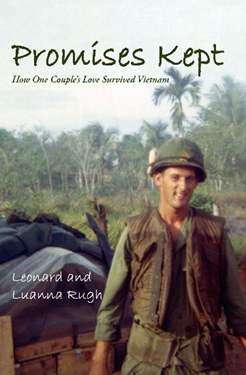
It was published in 2009 as Promises Kept; How One Couple’s Love Survived Vietnam.

Although Lu had written half of the second part of the book, she still told everyone, “I was a biology major. I’m not a writer.” Promises Kept won the 2010 EPIC Award for Nonfiction. It has become hugely popular with veterans’ groups.

While they were working on their book, I started a project with three other friends. It was an anthology about four sisters with a common through-story. However, one of the participants had to drop out because of health issues. We could have made it about three sisters, but the overall outline was for four.

I mentioned it at one of our weekly meetings. The following week, we went down to see Lu and Len at Camp Pendleton where they were spending a week camping. She asked me about the project, and I explained it to her. She asked if she could take part. By the time we left that day, she had outlined her character and the story she wanted to tell.

She was the first one finished with her novella! And hers became my favorite story in the book. Snowflake Secrets was published in 2008, before Len & Lu’s book. From then on, I told her she could no longer say she wasn’t a writer!
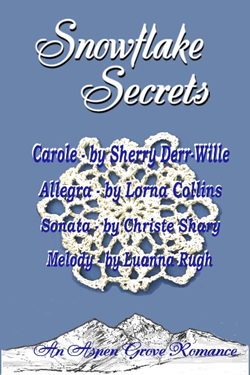


This was the first of six anthologies, all set in our fictional town of Aspen Grove Colorado, and Luanna was part of all of them. Seasons of Love came next, followed by Directions of Love, An Aspen Grove Christmas, The Art of Love and …And a Silver Sixpence in Her Shoe. Snowflake Secrets was a 2009 finalist for the Edward Hoffer Award, finalist for the 2008 Dream Realm Award, and a 2009 EPPIE award. Directions of Love won the 2011 EPIC ebook Award for best anthology.


I must have finally convinced her that she WAS a writer because she eventually published two more stand-alone novels: Love From the Sea was published in 2016, and Up in Flames published in 2020.


One thing we shared  in common was a love for everything Disney. We had annual passes, and they got military passes each year. We went with them often. Each time we passed the wheelchair rental, we’d suggest Len rent one.  “Heck no. Those are for people who need them.” Despite his total paralysis, he had learned to walk with a full leg brace (hip to ankle) on his left leg. His left hand was in a sling. He balanced by carrying a cane in his right hand. He’d learned to swing the brace while balancing on his good leg. He couldn’t drive, but he took the bus everywhere. Most of the drivers in Orange County knew him. When we were eating with them in a restaurant, someone would approach and greet him—often a bus driver.

He took part in classes to train physical therapists on how to work with people with his level of paralysis. He called them his “physical torture” classes. But he was proud to have been able to help train others to help people like himself.

He also took part in The Vietnam Head Injury Study. Every few years, he flew back to Washington D.C. for a week of tests and interviews. In later years, Lu went with him. They never could explain how he was able to accomplish so much with as severe an injury as he had sustained. Of course, the real secret was Lu. She knew when to push and when to step back. He never wanted sympathy or help when he didn’t need it, and those of us who spent time with him learned this quickly.

For years, the four of us ate brunch together after church on Sundays. During his last couple of years, Len was in and out of the hospital and rehab. Covid made everything much worse as he was often in quarantine. Lu was at loose ends without him to care for.

He was moved to a nursing home at some distance from their home, and she drove to see him several times a week. After Len died in 2022, Luanna lost much of her interest in life, and we saw her fading. Her memory began to fail, and her zest for life ebbed.

Finally, Sandra moved her into a lovely assisted living facility. She did better there, but she eventually started falling and forgot to take her medications. After yet another stay in the hospital, she was in terrible shape. Once again, Covid quarantines kept us from visiting. When we finally saw her, I was shocked. She could barely communicate, and she looked terrible. I called Sandra about our concerns. She said she couldn’t get any information from the facility and was very frustrated since she lived in Minnesota and Lu was in California.

Shortly thereafter, she moved Lu back to a facility a few minutes from her home. I couldn’t believe the change the next time I spoke with Lu. She was back to her old self! The caregivers at her new place monitored her medications and kept a close eye on her. And she flourished.

She made friends, played Bingo, watched movies, and cheered for the Vikings.

She was terrific for nearly a year. But then, she developed a UTI and was hospitalized. When she finally was well enough to return to her facility, her mental state had reverted to where it was when she left California. And she refused to eat. Being a type-2 diabetic, this contributed greatly to her downhill slide. She was put on hospice for a few days and just seemed to fade away.

I am convinced she is now with her beloved Len, where she has longed to be ever since he died. And I’m sure she is making jokes and laughing. At least, that is how I will remember her.


Friday, September 30, 2022

My Grandparents’ House

My grandparents, David and Mary Ann "Minnie" Methven, purchased the house at 423 Westbourne Dr. in West Hollywood, California in 1929. They moved from the house at 4125 Hammell St. in East Los Angeles, California.

My grandfather built the first house by himself when the family moved to California in 1919. He did everything except the plumbing because his brother-in-law was a plumber. The house is still standing all these years later, although it has been remodeled to such an extent that the original house is no longer recognizable. (I could not find a good photo of it.) Mother and I used to drive by it once in a while just to see if it still existed.

The new house in West Hollywood was much larger than the old house. The family now had three daughters and needed more space.


The story I was told was that the builder had intended to live there himself, but he had to move to another state. Grandpa heard about it from a friend and purchased it.

I have this small painting of the house. Grandma told me that during the Great Depression, itinerant artists went from house-to-house volunteering to paint them for a very small amount of money. The actual painting is about the size of a postcard. It is done on a thin piece of wood and is signed “O.J. Russert” and dated ’33.

Until her death, Grandma hung it next to the front door.

At the time I was born in 1946, my parents lived in the “little house,” an ADU behind the “big house.” My grandfather built the “little house” originally when his father came to live with them. Great-grandpa later moved to the third bedroom in the main house, and my older aunt and uncle, Gordon and Muriel Collin, moved into the “little house.”

It was originally just one room with a Murphy bed with a half bath (toilet and sink) attached. It never had a shower or tub.

When my aunt and uncle moved out, my mother moved in. She lived there when my dad was in the military in WWII. They were married on October 27, 1942 at the Wee Kirk o' the Heather at Forest Lawn Memorial Park when Dad was home on leave, and their reception was held at the house.


Dad and Grandpa added a lovely, large, sunny kitchen and breakfast nook on to the “little house.” My parents still had to go to the “big house” for showers and baths, but it was a cozy place to live.

After over four years in the US Army, Dad was discharged. He first reported on April 21, 1941 and served through November 24, 1945. Since Dad passed away at thirty-seven years of age, the loss of these four-and-a-half years was significant.

My earliest memories are as a baby waking up in my crib, which was shoved against one wall of the living room/bedroom. Mom and Dad were in the kitchen with the lights on entertaining friends. Smoke arose around them (Dad smoked) as they talked. I knew I was supposed to be asleep, and I tried to be as still as possible.

I remember the yellow kitchen with its sheer curtains. These are happy memories of a time when I was safe and cared for.

Every day, when Grandpa came home from work, he walked by the “big house” and tapped on the kitchen window so Grandma would know he had arrived. However, his first stop was the “little house” to see me. He carried me around and talked to me. Sometimes, he took me to the “big house” and pointed out objects: door, table, picture, window, etc. Because of this, I had a 52-word vocabulary at one year old. (Mom wrote all of them in my baby book because she was sure no one would believe her.)

When I was a bit older, Grandpa read to me. Although space was at a premium, the bottom drawer of the dresser was filled with books. Grandma and Grandpa and my parents bought me lots of Little Golden Books. Some of my favorites are still published. I wore out quite a few. It was through Grandpa that I learned to love reading.

Dad and Grandpa loved working together on “projects.” Grandpa adored Christmas. He and Dad built lots of decorations from wood and many “found” items.

They built a whole village of “tiny houses,” most of which were based on real structures. They created a village on the front lawn, surrounded by a miniature picket fence, and covered in Ivory Snow (washing machine soap flakes). They formed street lights from tin cans and wired them to illuminate the “village.”

Later on, they added a Santa on the roof, two large reindeers, and a sleigh full of presents. In this photo, a few of the “tiny houses” are along the wall.


Dad and Grandpa both worked at the Broadway Department Store in downtown L.A. They obtained the reindeer—previously used in a window display—when the store discarded them. After my family moved to Alhambra in 1948, the deer came with us.

Grandpa died of a heart attack at the Broadway at closing time on October 27, 1948. He was just fifty-five years old. I was twenty-six months old, but I still remember him. And I remember the night he died.

I have a memory of standing at the screen door of the “little house” waiting for of his footfalls on the driveway and the sound of his voice. They never came.

Unfortunately, most of the “tiny houses” were lost in a fire in Grandma’s garage a couple of years after Grandpa died.

Ironically, my father also died of a heart attack in the Broadway on February 16, 1954 at opening time. He was only thirty-seven years old.

My grandmother passed away on the 26th of March in 1969, while we were on the road driving to Illinois, where Larry had a job. When we called to let our parents know we had arrived, we learned that they had just attended her funeral. The house was sold a year later, before we returned to California.

I am grateful to have these photos of my grandparents’ home since it was the site of many lovely memories.


Tuesday, June 15, 2021

About Ghosts

Summer (along with the heat) has arrived, and it's time for a fun beach read. I have one: Ghost Writer.  It is a virtual trip to Laguna Beach, California--complete with a charming and annoying ghost. Here's a little bit about it--and ghosts.

From ghoulies and ghosties

And long-leggedy beasties
And things that go bump in the night,
Good Lord, deliver us!
~ Old Cornish Prayer ~

“I don’t believe in ghosts.” This is how Ghost Writer begins. My character, Nan Burton, adamantly insists she doesn’t believe. That is, until she's confronted with the noisy one living in her house.


I, on the other hand, do believe in ghosts. We had one living in our first house. Not a person, however. Ours was a cat.

Shortly after we moved in, I woke up on occasion with the sense of something walking across the foot of our bed. It felt like a small animal. I’d never owned a cat, but this didn’t feel like a dog, so I suspected a beastie of the feline persuasion.

After a couple of months, Larry and I both woke at the same time.

“It’s the strangest thing,” I started. “It felt like a cat has been walking across the bed during the night.”

“I’ve felt it, too,” was his matter-of-fact reply.

“Thank God! I thought I was going crazy.”

We speculated for some time about the cat, but he (or she) continued the nightly rounds.

Several months later, the woman who had grown up in the house stopped by. We showed her what we’d done to the house. She was very complimentary and told us stories about growing up there.

Just before she left, she asked, “Have you seen a cat around?” She went on to describe the cat, including what he like to do and where he liked to hide in the house. She mentioned that he’d patrol the house at night, his route taking him across each of their beds. Unfortunately we had to tell her that we hadn’t seen any animals resembling hers in the neighborhood.

“He disappeared the day my folks were moving. We came back and left food and left our contact information with all the neighbors, but we never found him.”

Her parents were the original owners and had lived there for seventeen years. The house had been on the market nearly a year before we bought it. So, any chance of locating the cat seemed pretty remote by that time.

We assured her that we’d keep an eye out, and she left.

A few weeks later, we realized that we no longer felt the cat walking across the bed.

“I wonder if it was the former owners’ pet. Maybe he was just waiting for them to come back before he could move on,” I told Larry.

“Hmm, maybe.”

A couple of years later, we adopted a stray kitten who appeared on our front porch. Like our ghost, our cat was nocturnal and roamed the house at night. We always kept our bedroom door closed, but in the morning when our daughter opened it, he’d take a stroll across the bed. And it felt just like the ghost cat.

How about you? Do you believe in ghosts? Have you seen any? Felt any? Sensed their presence? I’d like to hear your experiences.

Monday, May 24, 2021

ABOUT A BIRD

Luanna Rugh is a close friend. I have edited several of her books. In addition, she participated in all six of the Aspen Grove Romance Anthologies.

Luanna’s stories nearly always include animals—usually dogs. Quite a while ago, she began a story with a scarlet macaw as a principal character. Other projects prevented her from finishing it, but I always loved it—especially the opening.

Up in Flames is a romance with lots of complications.

“Nine—one—one. What is the nature of your emergency?” “Our bird’s stuck in a tall tree.” “Young man, this number is for human emergencies only.” “It is. Honest, lady. My mom was trying to get our macaw down. Now her foot is caught and she’s stuck in the tree, too. I didn’t know what else to do.”

A young widow with a son in a new town, a bird stuck in a tree, an unsympathetic fire captain—how can this lead to romance? Lyanna Thomas and her son, Davey, have moved to Aspen Grove Colorado following her husband’s death. When their macaw, Scarlet, decides to go adventuring, a whole new world opens up for the family.

When our writing group had to stop meeting due to the pandemic, I encouraged Luanna to finish the book, and I did the final edit and formatting.

Larry designed the cover. 


Luanna knows all about macaws and parrots because she has one herself. She totally conveys their behavior. Scarlet is definitely a pivotal character in the book.

If you enjoy romance with a sense of humor, you will love this book.


LUANNA RUGH was born and raised on a dairy in Central California. She always loved animals, cats and dogs, cows and horses, not to mention the many wild animals living in the area. At ten, she decided she wanted to become a high school biology teacher.

Her family moved to Southern California the year she entered high school. Luanna followed her path in college until the summer of 1966. She worked at a local restaurant where she met the love of her life, Len Rugh. They were married in February of 1967. A year and a half later, Len was drafted and sent to Vietnam where he was critically wounded, but that’s another story.

When Len returned to California, she finished school and earned two teaching credentials in 1984.

At age fifty-seven, she discovered she could write when she co-authored the first of the six books in the Aspen Grove Romance Anthologies. She contributed to all six of them.

After she and Len published their award-winning memoir, Promises Kept: How One Couple’s Love Survived Vietnam, she decided to stretch her wings, and write on her own. She loves writing animals as supporting characters. In Love From the Sea, a dog plays a major role. In Up in Flames, another dog and a scarlet macaw are lead characters.

Her books are available in paperback and Kindle editions. Most are also available as audiobooks.

She hopes you enjoy reading them as much as she loved writing them.


Monday, May 17, 2021

A TALE OF TWO CULTURES

I met Carol Van Kirk at church. When she discovered we were authors, she said she had been working on a book for years. I invited her to join Lagunita Writers, our critique group.

She brought chapters of her book, and everyone looked forward to learning more of her story each week. Her writing was outstanding, and she had a compelling story to tell.

Then came the pandemic…

The group stopped meeting, and the majority did not want to continue via Zoom.

I knew Carol was anxious to get her book finished and published. I called her, and we worked on the edit together. When it was ready, she published it.

Her husband, Nick, a graphic artist, produced an amazing cover.


The Yellow Lizard: A Tale of Two Cultures is Carol’s memoir. Written with contributions from her daughter, Allison Langbridge, Carol tells the bittersweet, and often funny, story of sharing the raising of her children between Southern California and Tahiti.

As a recently divorced mom of two teenagers, Carol agreed to paternal visitation rights of every other weekend and a month in the summer for her children. Soon after the marital dust settled, however, Dad moved to the remote island of Moorea in French Polynesia, aka Tahiti.

Thus began summers in Tahiti for these two over-indulged kids. Eventually, Allison graduated from school and settled into a conventional job and lifestyle in California. Her brother Alec, however, fell in love with and married a local vahine, Anne. This bicultural couple launched a vagabond lifestyle between an Island Paradise in the South Pacific and staid Orange County, California, filled with adventures, mostly comical and implausible. When two children arrived, however, they settled into a house in Opunohu Bay on Moorea. Subsequently, Grandma Carol became a regular visitor on this island that many people, including James Michener, have referred to as the most beautiful island in the South Pacific. Over the years, she became familiar with the Tahitian traditions and superstitions, some she embraced, others she found amusing, absurd, and sometimes downright scary.

But when tragedy struck, it was the Tahitians, not her American friends, who brought peace and comfort with their close spiritual connections to nature. Who then, she wonders, are the unsophisticated primitives?

The book includes many photos. I created a video trailer for it (something I rarely do for books I edit).

The book is available on Amazon in print and Kindle versions. I’m sure you will enjoy reading about her adventures in Paradise.

CAROL VAN KIRK is a technical writer and editor, who has written for various publications including alternative healthcare periodicals, trade journals and technical manuals, training manuals and online computer Help systems. She was copy editor three years for the magazine Yerevan, which was circulated internationally.

The Yellow Lizard was written as a project to share her family’s unusual background and history with the younger generation, but it soon grew into a full-fledged memoir. She is currently at work on a book of myths and legends of the Maohi Tahitians. Carol currently lives in southern California with her daughter and great-grandson.


Sunday, May 9, 2021

A MOTHER’S HEART

Another book I loved working on was It’s Amazing – She Looks Just Like You: The Story of Sophia and Me, by Dawn Mauro with Carol Ann Mauro.

Dawn always wanted to be a mother, but the husband/partner in the equation never appeared. She tried all the options here in America to become a single parent, but for one reason or another, they did not work out.

By what can only be described as divine intervention, she was led to All God’s Children International (AGCI) in Nepal. She recounts the arduous journey of application, multiple forms, and other requirements—and lots of waiting, expense, and red tape—before she was finally approved for adoption.

So, she and her mother, Carol, set off for Kathmandu, and the adventure of a lifetime. Her determination was tried many times, but she felt God had led her to this place and this orphanage—and this child.

Carol contributes her memories to the book, adding a special dimension. The love of these two women, provided the foundation for the love of this precious child.

In editing the book, I got to know both Carol and Dawn. Their deep love of the orphans of Nepal transcends Sophia’s adoption. Carol; has become a major supporter of the orphanage and is now known as the “godmother” of the children there.

I so loved all the beautiful photos Dawn included in the book that I prepared a video trailer for it. (This is something I rarely do for the books I edit.) 


Their story is a triumph of hope and love. It is inspiring and will leave you with tears of joy. It’s a feel-good read you will truly enjoy.

Sophia just became a teenager, but she continues to inspire. She recently shaved off her long hair in order to make wigs for kids with cancer. You will not regret getting to know this inspiring family.

Monday, May 3, 2021

ON THE WINGS OF FREEDOM

 I recently wrote about my ancestor, William Blackwood, who was a publisher and editor. In the last few years, I have done more editing and publishing than writing. I love helping others achieve their dreams of being published authors. In the next few weeks, I will share with you some of the wonderful books I have been privileged to work on. (I help the writers I work with to self-publish their books so they have total control over them.)

One of these books is On the Wings of Freedom.

I was recommended to first-time author Malanna Carey Henderson as an editor. (These days, most of my editing is done for people on the recommendation of others.)

The book contained a McGuffin—a bird in flight carved out of bone. (McGuffin is a term coined by Alfred Hitchcock for an object that serves as a trigger for the plot. Think of the blackbird statue in The Maltese Falcon.) Strangely, I had one! My dad had sent it to my mom when he was in the service in WWII. It had a letter in its mouth, but Larry assured me he could remove it digitally.

This felt like a sign that I should work on this book. I also liked the theme and plot.

Because we write historical fiction, I was well-aware that readers of the genre will destroy an author in reviews if they get anything wrong. Unfortunately, I discovered quite a few things in this manuscript that were inconsistent for the period. Thank goodness, Malanna was willing to do the necessary research—and rewriting—to make it correct.

During the writing process, I mentioned the carved bird to my daughter. “I have one, too,” she responded.

Shortly afterward, we went to visit her, and she showed it to me. It had been with my mother-in-love’s jewelry. Neither she nor I nor Larry knew whose it was originally. I really loved this one. It was in full flight and precisely the image Malanna had described.

Larry liked it, too and used it for the cover.

When the book was published, my daughter said I could send the original bird to Melanna to be used for whatever purpose she chose. Mine will go to my daughter, and she will know the story behind it.

This is the synopsis of the story:

Born free in New York City, Carrie Bennet is unprepared to hear the family secrets her ailing mother, Sarah, reveals. An educated woman who has led a sheltered life, Carrie travels south to fulfill her mother’s dying wish―to free her grandmother from slavery. Circumstances set her on a perilous path that jeopardizes her freedom and leads to a charge of murder. Fearing she’d never get a fair trial, Carrie travels north on the Underground Railroad and joins Harriet Tubman. As her life hangs in the balance, Carrie fights an unjust judicial system as she struggles to deny a forbidden love.

Malanna Carey Henderson has written and produced ten plays which have been performed in Brooklyn, New York; Culpeper and Fredericksburg, Virginia. For the past two years, she has worked with members of the Friends of the Wilderness Battlefield, Shiloh Baptist New Site, the United Methodist Church, and St. George’s Episcopal Church to produce vignettes under the title: Untold Stories. These vignettes focused on little-known historical events featuring the contributions of African Americans as spies and military heroes to celebrate Black History Month. The one-act plays included To His Excellency George Washington, Camp Casey, It Was a Matter of Pride, Democracy is a Weapon, Secret Codes and The Pension Office.

In 2009, she won first place in the One-Act Play Festival sponsored by Stage Door Productions for The Eclipse. She won a first-place award sponsored by the Tulsa City County Library for A Question of Color.

A native Detroiter, she earned a Masters of Fine Arts degree in Creative Writing from City University of New York, Brooklyn Campus and a Bachelor of Arts degree in Liberal Arts from the University of Detroit.

On the Wings of Freedom is her first novel. She lives in Fredericksburg, Virginia with her wonderfully supportive husband.

Malanna as a Civil War reenactor

I hope you will give the book a try. I’m sure you will enjoy it as much as I have!

I will continue to share some of the wonderful, but little-known, books I have been privileged to have worked on.

Friday, February 5, 2021

Discovering Dana Point

 I doing research for our book, The Memory Keeper, I found photos of a statue called “The Hide Drogher.” Drogher is a word for the slow, clumsy coastal ships, which stopped in Dana Point to trade foreign-made goods for hides. The statue shows a sailor tossing a hide. I remembered seeing the statue many years ago, but when we were doing our research, I couldn’t find it.

I looked it up and discovered it was on the top of the bluff along the Bluff Top Trail. It used to be visible from the road along the bluff, but now, large homes have been built there.

 Today, after a stop at the post office, we were on Amber Lantern. I asked Larry if we could stop and take a walk on the trail.

The view was gorgeous from the gazebo-structure at the end of the road.

To call this a “trail” is a real misnomer. It is a concrete path with series of stairs, all with handrails.


Not far along the trail, we saw the arches from the 1930 construction of the original Dana Point Hotel, which was never completed because of the stock market crash and the Great Depression.


A plaque describes the wall and the circumstances.

Not far beyond the arches, we spotted the statue. It is now enclosed in a wall of concrete. (It used to stand alone on top of the bluff.)


The plaque describes the statue.

On the way back, we were able to see the old trail, which used to zigzag down the cliff to the beach below. Larry remembers hiking up the trail in the 1960s. Of course, much of the old trail has been washed out over the years.

The trail was lined with rock walls, some of which can be spotted below the new trail.


We took some photos with Larry’s phone, but they didn’t come out well. So, we went back and retraced our steps later on. Two hikes in one day! What a gorgeous time to enjoy our hometown!

Now that we know where the statue is, we may visit it more often.

 Are there places in your hometown you haven’t explored? So glad we discovered this one!

Saturday, October 3, 2020

Yet Another Loss

 Marilyn the Crazy Italian is gone. Actually, she was Sicilian—and proud of it! Through her, I discovered that if Sicilians liked you, you became family. We became a part of her feisty, funny, loving Sicilian family, and we were blessed for it.

 Marilyn and Don Griffin were our neighbors. They had an only child, Donna. We had an only child, Kim. The girls were in the same class in school when Donna infected the whole class with chickenpox.


This is about how Marilyn looked when we first met.

When we met, Marilyn and I instantly bonded. I loved her irreverence and sense of humor. I think she liked my pragmatism. I was also a good audience and laughed at all her jokes. And she knew I loved her. We told each other the truth, and it mattered to both of us.

I loved her whole family: her crazy mother, Mary, her Auntie Dolly and Uncle Cliff (they were also neighbors), and Auntie Alice and Uncle Louie (she called him “Uncle Loulie”). We got to know all the cousins and enjoyed them as well. Over time, I also got to know her brother Sammy (Sal), too. He sold me a car once—one I adored.

 Kim and Donna were in the same Brownie troop, so we often saw each other at various meetings. When I took over the leadership, Marilyn became an assistant leader. This continued through several years of Girl Scouts.

 Larry and Don got along well. Both were the same age, very shy, and didn’t like large crowds. They sat at a distance together and observed. I remember one neighborhood Christmas party at our house. Everyone sat around the living room in a circle. Before long, Don and Larry had backed away to the far corner of the dining room where they could watch everything without engaging.

Our families began to spend time together at each other’s houses. About once a week, we ate dinner together and then played games. The guys’ favorite was The Ungame. I think they liked it because it wasn’t competitive. After a while, we abandoned the board and tokens and just answered questions. In this way, we all got to know each other very well.

 In 1980, Don fell at work. Because it happened on the job, his employer insisted he see their workman’s comp doctor. Early the next morning, we received a panicked phone call from Marilyn. Some of Don’s tests indicated something seriously wrong, and all the possibilities were fatal.

 Instead of leaving for work, we rushed to their house where we held each other and cried. Thus began several of the worst months of our lives. Don had leukemia, which at the time was an almost guaranteed death sentence. He underwent a bone marrow transplant at City of Hope, which appeared to be successful. However, as he was recovering, he had a brain aneurism and passed away. He was thirty-six years old.

Marilyn had a difficult time after Don died. Then, women couldn’t get a credit card in their own names. This motivated me to get a loan in my name only. I had to fight the bank to do it, but I got it—and paid it off in half the time.

Two years later, Marilyn married again, this time to Louis LaVella, who had two daughters. Family was always most important to her. She met her new husband through Parents Without Partners.

Unfortunately, Louis had severe heart problems. He died while on a transplant list, and again, Marilyn was alone.

Marilyn and Donna

Several years later, Marilyn reconnected with a former high school boyfriend, Fred Martin. Both were single, and their old spark rekindled. They were very happily married until Fred’s death in 2003.

Marilyn took Fred’s death very hard. She was at loose ends for several years. She finally joined a support group for widows and widowers. There she met Ray Bondeson. I remember when she called to invite us to their wedding. The big incentive for Larry was the red velvet cheesecake wedding cake!


Marilyn and I remained in touch through Facebook and occasional phone calls. We always talked about getting together, but we didn’t manage to do so. She called several weeks ago, and we spoke for about an hour, sharing memories of our mothers and families and our kids. She was very proud of all her kids and grandkids—including the step ones. She mentioned she was in the hospital, but for as long as I’d known her, she always had one or another physical issue. Hospitalization wasn’t unusual for her, and I didn’t think too much about it.

Her stepdaughter posted the news of her passing on Facebook. I am heartbroken to realize the phone will never ring again and I will never hear her smoky voice and hearty laugh at the other end.

Rest in peace, my friend. I’ll never forget you.