Tuesday, April 12, 2016

Giving Away Book copies

Since we write books and have them published, family members and friends sometimes expect to receive free copies. However, authors can’t afford to give them away, as much as we might like to. Here are the reasons.

AUTHORS PAY FOR THEIR COPIES
Publishers don’t just give authors copies of their books free. For print books, the paper, ink, and printing all incur cost. So does shipping. If a traditional publisher publishes the book, they usually provide editing services and the cover art at their expense. When the book sells, the publisher and the printer receive the bulk of the proceeds. The author is paid only a small percentage.

Publishers charge for author copies, although at a reduced rate from the retail cost. In addition, the author must pay for shipping.

For self-published books, the cost is reduced, but not enough to hand out copies to everyone who might want one.

Even though it is possible to self-publish at no cost, additional expenses are required.

COVER COSTS
To produce a professional book, it is necessary to pay for unique cover art as well as hire a professional to lay out the print cover. It is possible to download stock cover art at little or no cost, but your book will look “generic,” and others may share the same cover design.

For The Memory Keeper, our friend and artist, Robert Schwenck, allowed us to use his beautiful painting of the ruins of the old stone church of Mission San Juan Capistrano on the cover. We hired Melissa Summers, who designed quite a few of our other books, to create the print cover. We are delighted with the result.

Larry is an artist himself. Several of his pieces decorate our home. He was able to create the covers for his sci-fi series, The McGregor Chronicles, using NASA star field photos, which are in the public domain. He was also able to create his own layout using the CreateSpace templates. Because this series came after we had already published several previous books, he understood the requirements. Most authors do not.

PROFESSIONAL EDIT
Regardless of which way the book will be published, every writer should hire a professional editor before submission to ensure the integrity and professionalism of the finished product. I am a professional editor, but even I can miss critical issues in my own books.

MARKETING AND PUBLICITY
Additional hidden expenses surround each book launch. In the past, we ordered inexpensive business cards printed with the name of the book, and handed them out for several weeks prior to publication.

We've also created our own video trailers for each book. However, some of our author friends pay others to create professional trailers and post them to their social media and websites.

Every author should have both a blog and a website. Website hosting and web design can be quite expensive, but the site should look professional. We are blessed with a son who took over the design and maintenance of our site several years ago. He does this for a living, so he has the necessary skills to produce an eye-catching and user-friendly website (www.lornalarry.com). Most people do not have this resource, so they need to pay someone as their webmaster.

We also plan a book launch event in conjunction with each new book. During the event, we serve refreshments and hold a drawing for prizes. All incur cost.

Unfortunately, published authors make considerably less today than in the past for a number of reasons. Even ebooks are not free. We can gift copies to people, but we have to buy them in order to do so.

So, although we’d like to be able to give our books to all our friends and family members, we are not independently wealthy enough to do so. When we do give someone a copy, please understand it is a gift with inherent cost to us.


Tuesday, April 5, 2016

Writing Animal Characters

Today,, Larry K. Collins, my husband and sometime collaborator, is my guest blogger. He tells about writing animal characters. His latest sci-fi venture, The McGregor Chronicles, features a cat, and he shares the issues he had writing this feline. 


When I was growing up, my family ran the gamut of pets. There were dogs, cats, hamsters, turtles, ducklings, chameleons, and goldfish. The latter three were acquired from various contest booths at grammar school carnivals. Remember “toss a ping-pong ball into the top of the bowl and win a fish?” The tiny goldfish came home in a water-filled plastic bag. Unfortunately, for my brother and me, none of the carnival animals lived long.

Dogs and cats were another story. The first, a cat, arrived when my mother found three-year-old me sitting on the back porch, petting a full-grown tabby. “Can we keep her?”
I named her Jezebel, not knowing she was a he. We got a clue when every kitten in the neighborhood began to resemble my cat. He would butt his head against my hand when he wished to be petted, a trait I wrote into The McGregor Chronicles series as a cat called Knucklehead. Jezebel lived with us for fifteen years.

The dog, a blonde cocker spaniel named Candy, arrived when a neighbor family moved out of state and could not take her with them. The four-footed refugee immediately bonded with my family. The dog had been quite yappy when in the neighbors’ care, often waking us at night. But when she arrived, my dad pointed to her and said, “I’ll have no barking dog living here.” Her eyes grew wide. She must have understood, because after that, the only time she ever barked was when the mailman or first-time strangers came to the door. She became guard and protector for the family.

In high school, my first job was working nights in a gas station. By then Candy was old, deaf, and nearly blind. She would abandon her bed to sleep with her back against the front door so she knew when I got home. If I was late, she would go to my parents’ bedroom to tattle, bumping the mattress as if to say, “He’s not home yet.”

After Lorna and I married, new pets entered our family.

There’s a saying, “Dogs have masters. Cats have staff.” It was certainly true of the cat we inherited from a relative, an obnoxious Siamese.

Foxy demanded attention but only on her terms. She sat just beyond arm’s length and yelled for us to pet her. Which meant we had to get up to comply. Foxy shared a fragile truce with our gray, mini poodle, Shadow. It lasted only as long as neither acknowledged the other’s existence. They passed in the hallway, each looking in opposite directions. But the cat ruled the house.

When I decided to include an animal in my Sci-Fi series, The McGregor Chronicles, I opted for a cat. The physical description of my fictitious feline, Knucklehead, came from the tabby of my own youth.

The temperament, however, was from another cat. Not just any cat. I based it on my favorite all-white feline, Pippin. He fit none of the usual cat clichés.
He was regal. He sat on a shelf or the back of the couch, head held high, front paws together, and tail wrapped neatly around his paws. Unmoving, he looked like a statue. Strangers often jumped in surprise when, after five minutes, the statue next to them looked their direction. He never demanded attention, but was friendly and loving. If one of us was sad or depressed, he sensed it, and wanted to be near, preferably on a lap. His steady purr soothed my young daughter’s tears. He allowed her to dress him in doll clothes, toss him over her shoulder, and carry him around. He never complained, but I remember a pleading look entered his gold eyes as he stared back at me from Kim’s shoulder as she carted him away. I knew I’d soon have to rescue him.

Most cats don’t like riding in the car. Pippin loved it. Sitting motionless in the back window package tray, he often got surprised looks from people in nearby cars. If it was cold, he sometimes wrapped himself around my neck and shoulders, like a fur collar. From there, he could watch out the side window, startling those who drove by.

I introduced my cat character in the second book of the series, Escape From Eden, and plotted a larger role for him in the third book.

However, as I began writing the third story, Alien Invasion, I got a serious pushback from the animal. Just like a real cat, he refused to do what I wanted.

Knucklehead complained. “First, I’m not a he. I’m female. And I don’t like my name.”

This cat acted more like the obnoxious Foxy than my compliant Pippin, or even Jezebel, but “she” put a paw down, and would go no further.

Since book two had already been published, I had to modify my story to account for the new name and sex change. Knucklehead became Qittah.

Further into the story we hit another impasse. I had thought to have Qittah interact directly with the aliens. She refused. “Your stories are more science than fantasy. Keep it that way. I don’t want to talk to aliens, and I’m in no way magical. I’m just a cat.“

Again, she was right. As a normal cat, she could provide comfort to a character during a dark time in the story and bring out the softer side of other characters. Plus, her adventures with weightlessness and the other aspects of space travel added realism to the final work.

This wasn’t what I intended when I placed a cat in the story. But, I think it made the tale better, and Qittah seemed to like it.

Do you use animals in your stories? And if so, how?


Tuesday, March 29, 2016

Lasting Love - Part 5

This is the final installment of my blog series on some of the reasons we have managed to remain married for over fifty years. (I know some people think it’s about time for it to end.)

5. Humor and Respect

For many years, I’ve told Larry I keep him around because he makes me laugh. There is a great deal of truth in the statement.

I was raised in a family of dour Scots. They took life VERY seriously. I was an extrovert. They were mostly introverts. Until I met my dad’s younger sister after years of separation, I never knew where my personality came from. (It was from the Irish side of his family.)

Aunt Mary Evelyn was absent from our lives growing up. After Dad died, we lost track of nearly all of his family. Years later, she contacted me, and we began to spend time together. She was hysterically funny. (I didn’t get all of that gene, but I was a great audience.) We laughed at the same jokes and quoted the same quotes.

But I really learned about humor from Larry’s family.

His grandfather, Harry Burton, was one of the funniest people I ever met. Harry’s sister, Margaret, was also a kick.

Larry’s brother, Casey, inherited the Burton comedic gene as did their cousin, Jim Tedford. Any of them could have made a living as stand-up comics.

Larry’s dad had a more subtle sense of humor, but he was also very funny. During the years when Larry’s mother was bedridden, we visited every Sunday. I stayed with Mother while Larry and Casey got Dad out of the room for a bit. One of my favorite memories is hearing the three of them laughing in the next room.

Casey has the ability to find humor even in serious circumstances. He is able to see the irony and ridiculousness in the human condition. The lady at the mortuary, where we met to make Dad’s final arrangements, thanked us for making her day. Dad died at 94 years old, after a long and happy life. He had made all the arrangements himself, so we were relieved of decision-making—except for the flowers. When she asked what we wanted, we looked at each other.

Finally, I said, “Dad wasn’t really much of a flower guy.”

This set Casey off on a series of speculations and references to their mother’s arrangements five years earlier. (She had obviously picked out what she wanted, and we had all enjoyed a laugh at how predictable her choices had been.) We finally decided on a military tribute—the perfect choice. But we also shared great memories and a few laughs in the process.

Larry had to teach me how to be less serious, and I am forever grateful to him for the lesson. He continues to make me laugh, so I’ll keep him for a while longer.

Humor can sometimes be cutting and insulting, however. I know couples who use humor as an excuse to berate each other. Not funny.

Early in our marriage, we were reminded to treat each other with the same respect we would give to our friends. It is easy to get testy with each other when circumstances don’t go our way. (I am sometimes guilty of this!) When I hear short words come out, I try to immediately remind Larry I’m upset at the circumstances, not at him.

For years, when I fixed a meal, Larry thanked me for it. He still does, even after the thousands of meals we’ve shared. Now that he does some of the meal preparation, I return the favor. I genuinely appreciate his efforts, and I tell him so.

I probably could add even more reasons we’re still together, but I’m most grateful for the examples of his grandparents and parents, who showed us how to do it.

We’re here because they showed us the way.


Did I miss anything? Do you have any other secrets?

Tuesday, March 22, 2016

Lasting Love - Part 4

I’m continuing my series on some of the reasons we have managed to stay together all these years. Here’s another.

4    Communication


When we were first married, I expected Larry to know what I needed by osmosis. I figured if he loved me, he’d figure it out. Didn’t happen.

I tried hinting. That didn’t work either.

I finally figured out guys were just clueless.

Fortunately, early in our marriage, we attended a couple’s retreat. The leader asked, “Are you mind readers?” We shook our heads. “Then how can either of your know what the other needs or wants? You have to tell each other. Men don’t do subtle. They need direct answers.”

I hadn’t thought about it in those terms. How could he know my needs if I didn’t tell him?
.
A few years later, I read the book Love, No Strings Attached. It changed my life so much that I led a study on it at church. One of the techniques the author suggests is for each partner to write two lists:
·         What I need to feel loved
·         What I do to show you my love
Then we numbered the first list from most important to least.

We exchanged lists. What a surprise! Larry didn’t know how important remembering birthdays and special occasions was to me. (Number one on my list.) I didn’t know he showed his love by washing my car. (I just thought he wanted clean cars.)

I learned to tell him when I needed something without waiting for him to figure it out on his own. And he learned to listen.

I also think it’s important to say the words, “I love you.”

Larry’s mother told me once the only time Dad told her he loved her was on their wedding day. Their pattern was that she said, “I love you, Murl,” and he replied, “Me, too.”


I used this as a theme in “Finding Love in Paradise,” my novella in our award-winning romance anthology, Directions of Love. (I also included Larry’s non-proposal in this one.)

Dad showed Mother his love her entire life, but he almost never said the words.

Larry, on the other hand, has said them often—at least two or three times a day. The words matter to me, and he knows it.

From another couples’ retreat, we learned to be more effective in our communication by using ‘on a scale from one to ten’ to indicate how much we want (or don’t want) to do something. I remember one time when Larry wanted to see a really stupid (IMHO) movie. When he asked if I wanted to go, my answer was, "Is there anything less than zero?”

He took Kim, and I took a bubble bath, got into bed, and read for the evening. We were both happy, and we both knew we’d gotten what we wanted.


How do you communicate? What kinds of things are most important to you?

Tuesday, March 15, 2016

Lasting Love - Part 3


I’ve been sharing some ideas about how we’ve managed to remain married for over fifty years. Here’s another.

3. Play Together
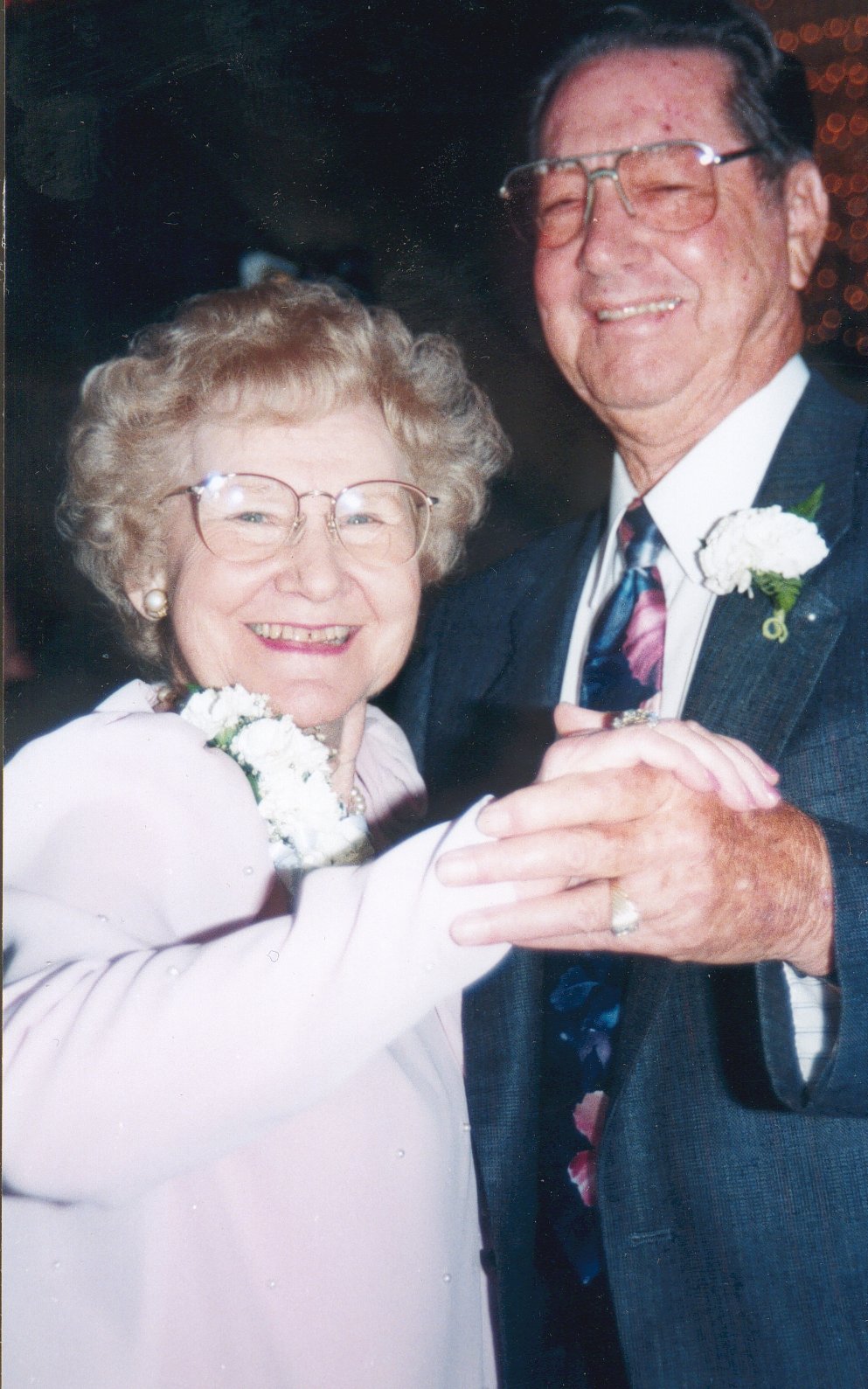
Larry’s parents loved to dance. Dad actually danced professionally as a teenager. He and Mother were fabulous ballroom dancers. On their 60th wedding anniversary, they were still better than we’ll ever be.
Dancing brought them both a great deal of pleasure.

It doesn’t mean they did everything together. Dad was an avid golfer. After they retired, Mother took lessons, but she didn’t really enjoy it. Dad was exceptionally good, and she was never interested enough to improve sufficiently to play at his level. But she enjoyed going with him to tournaments where he competed while she shopped.

Shopping was Mother’s greatest delight. She went out every day—often just to check the stores. Sometimes she’d find an item she liked. She’d check on it for weeks. If it was marked down, she bought it. If it was sold, she figured she didn’t need it.

Four years before their 60th anniversary, they danced at our daughter, Kimberly’s, wedding. They wowed the crowd at the reception.
One other couple on the floor danced as well: my Aunt Evelyn and Uncle Frank.
They took lessons every week and danced every weekend for years. They celebrated their 72nd wedding anniversary last August. I put together this video to honor them. At the end is a short clip of them dancing at a pumpkin patch last October.
In 2011, Aunt Evie had a stroke. The first time she was allowed to get out of bed, Uncle Frank held her and danced her around the room. I’m sure it’s one of the reasons she recovered so well physically—she never stopped dancing.

Larry was too intimidated to dance much. So was his brother. With parents as good as theirs, they felt they’d never measure up.

But we found other ways to play together. We love theme parks, and have had annual passes for Disneyland for years. When we were working, we’d often meet at the park for dinner. Then we’d walk around and enjoy the lights, visit the attractions, and watch the people.

Our love of theme parks led to our building of Universal Studios Japan. Living in Japan was difficult, but doing it together got us through. In the end, we felt a great sense of accomplishment. Returning ten years later made us even prouder of the world-class venue we had helped create.

Our sojourn in Japan led us to our second career as authors. When we returned, we wrote our first book: 31 Months in Japan: The Building of a Theme Park.
Now that we’re retired, play includes writing together. Since 2005, we’ve published fourteen books between us, with number fifteen to come soon.

We also love to travel and have visited and vacationed all over the world. Now that we’re authors, we are often asked to speak at conferences and for other groups. We enjoy meeting people and seeing new places.

We each have our own interests, too. Larry still loves surfing and tries to go every weekday. I love spending time with friends, editing, and reading.

Play is just as important for adults as it is for children. How do you like to play?